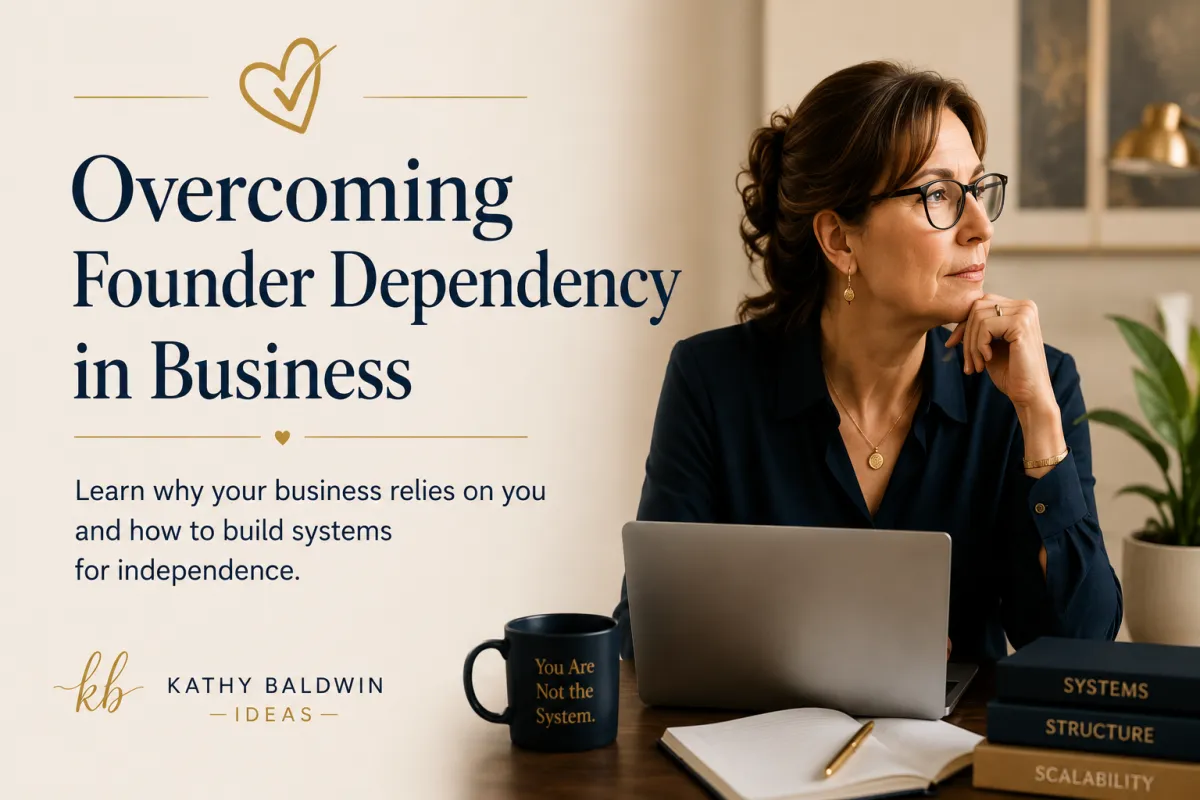
Why Your Business Still Depends on You for Everything
Founder Dependency, Founder-Led Business, Business Systems
Why Your Business Still Depends on You for Everything
Your business may look successful from the outside and still be built around your constant availability. Clients are served. Revenue comes in. The team keeps moving. Yet decisions, explanations, exceptions, and reassurance continue to find their way back to you. This article explains why an established founder-led business can run on real revenue and real results while remaining founder-dependent, and what to build instead if your business still depends on your memory, judgment, and presence to function.

Your Business Is Not Broken. It Is Missing Architecture.
Why everything still runs through you and what to do next.
A business can look successful and still be founder-dependent
You know your business is working because money comes in, clients renew, and referrals keep showing up. You also know that when you stop watching the details, things wobble quickly. You cannot disappear for more than a few days without decisions, questions, and small fires stacking up and waiting for you to return.
Your team is capable. Your clients are smart. You are not surrounded by incompetence. Still, you find yourself:
answering the same questions in slightly different ways every week
clarifying what “good” looks like before work can move forward
stepping in to fix delivery problems no one else spotted early enough
You are not imagining this. The business really does depend on you for everything that matters. That does not mean you are bad at delegation or secretly addicted to control. It means you have been compensating for missing business architecture with your own brain and body.
“The business works because you work.”
What founder dependency actually means
Founder dependency is the condition in which a business cannot consistently sell, decide, deliver, reassure, or grow without the founder’s personal memory, judgment, explanations, approvals, or intervention.
In many founder-led companies, the founder is treated as the operating system. Every meaningful action relies on your brain to supply context, standards, decisions, and exception handling.
The founder is not the operating system. A durable business needs an operating system that exists outside the founder’s head, even if it is guided by the founder’s values and perspective.
At Finally Business Systems, this is the core assumption: the founder’s knowledge is an asset that belongs inside the business architecture, not trapped inside the founder’s nervous system. Founder dependency is a sign that this transfer has not happened yet.
📌 Key idea: Founder dependency is operational data. It is telling you exactly where the business lacks structure. It is not a moral verdict on your leadership.
Where founder dependency hides
Memory: “Just ask me, I’ll remember”
You remember client preferences, old conversations, unusual agreements, pricing exceptions, and the real story behind each relationship. People rely on you as the living archive. This works until your memory becomes the only place critical information lives. The business depends on the owner because the CRM, documentation, and workflows are not yet carrying that intelligence in a usable way.
Translation and repeated explanation
You find yourself re-explaining the same concept to team members, vendors, and clients. You translate your expertise, your standards, and your “why this matters” every time work crosses a boundary. That pattern shows that your logic has not been captured in reusable content, decision frameworks, or training that people can trust without direct access to you.
Decisions and approvals
Projects stall while people wait for your “yes,” “no,” or “not like that.” The issue is rarely that your team is incapable of deciding. They do not have your decision criteria in a form they can apply. A system is only as useful as the business logic underneath it. If that logic is still in your head, the system routes every meaningful decision back to you, even if the software looks polished on the surface.
Sales clarity and positioning
You close deals because you can read the room, adjust language, and connect the offer to what this specific buyer cares about. When someone else sells, the message feels thinner, more generic, or slightly off. The business depends on you because the real sales logic lives in your live conversations, not in a clear structure that others can learn and apply. Your voice is not yet embedded into the sales system. If this pattern feels familiar, you may find it useful to read You Are Not the System for a deeper distinction.
Client reassurance and trust
When clients get anxious, confused, or frustrated, they want you. Your presence calms them because you can name what is happening, explain the path, and reset expectations. If reassurance depends solely on you, then your business has not yet built structures that create safety: clear expectations, transparent progress markers, and communication rhythms that carry your voice without requiring your live attendance every time.
Delivery rescue and exception handling
You are the one who notices early when a project is drifting. You step in, reset scope, or redesign the solution. You are also the one who handles unusual client situations that do not fit the standard process. That tells you the delivery system has not been given clear patterns for what “normal” looks like, what early risk looks like, and what to do when reality does not match the template. The founder is often where the missing system hides, especially around exceptions and nuance.
Tools and technology
You may have a CRM, project management platform, automations, and shared folders. People still DM you for the “real” answer or the “right” version of a document. Software is not automatically a system. A tool becomes a system when it carries clear logic, roles, and pathways. If the tech stack feels busy while everyone still checks with you, the architecture is incomplete, not the people.
Growth and strategic decisions
New opportunities, partnerships, and offers usually land on your desk. You decide which ones fit, how they should be shaped, and what the business can realistically absorb. This is part of your role as founder. The problem appears when every growth move requires you to manually compensate for fragile operations, unclear capacity, and fuzzy decision rules. Growth then amplifies dependency instead of creating leverage.

Mapping where work really relies on you reveals the missing architecture beneath activity.
Why hiring more people often does not solve the problem
Many founders respond to overload by hiring: an assistant, an operations person, more delivery capacity, or a sales resource. Hiring can be useful. It does not automatically reduce founder dependency. Without clear architecture, you are asking people to fill a role that exists mostly in your head. They end up shadowing you, chasing you for clarification, and building their own private workarounds to get things done.
When the business depends on the owner’s unspoken logic, new hires either:
become informal translators who still route critical decisions back to you
make guesses that create rework, friction, or brand drift
In both cases, your calendar fills with “quick” clarifications. You feel pressure to be more available so your team can succeed. This is not a delegation failure. It is a design problem. The architecture that would enable real ownership has not been built yet, so people cannot reliably carry what still lives only inside you.
Why software, automation, and AI can make the problem faster
Tools are multipliers. They multiply whatever logic and structure you give them. If the underlying business logic is fuzzy, fragmented, or still sitting in your head, technology will accelerate that confusion. The forms look clean. The automations run on schedule. The dashboards are polished. Meanwhile, your team still checks with you before they trust what the tools say to do next.
AI can draft emails, summarize notes, and suggest responses. It cannot invent your standards, ethics, or strategic judgment. Those must be articulated. A system is only as useful as the business logic underneath it. If that logic is missing, software simply moves the same dependency faster, with nicer interfaces and more notifications demanding your review.
💡 Pro Tip: Treat every new tool as a container that needs your explicit logic. Ask, “What decisions should this tool be allowed to make, and based on what rules?”
Delegating tasks is not the same as extracting founder intelligence
Delegation moves actions off your plate. Extraction moves your intelligence into the business. You need both, in the right order. Many founders skip extraction and jump directly to delegation. They hand off tasks without handing over the patterns, context, and criteria that make those tasks effective when they do them personally.
Extracting founder intelligence means identifying:
how you recognize a good fit client versus a poor fit
what you look for when you scan a proposal or deliverable
how you decide when to say “yes,” “no,” or “not yet”
Then you translate those patterns into decision frameworks, checklists, scripts, templates, and training that the business can carry. Delegating tasks without this extraction keeps the founder bottleneck in place. The work moves, but the real authority and clarity stay parked in your head.
Founder intelligence must be extracted before it can be systematized. The goal is not to automate everything. The goal is to assign the right work to the right carrier.
If you want a deeper diagnostic on where your intelligence is hiding inside the business, you can use the Finally Diagnostic as a structured starting point.
Questions that reveal where the business still depends on you
Use these questions as a quick scan. Answer them honestly, without self-judgment. The goal is to surface data, not guilt.
What stops moving when I am unavailable?
What decisions still return to me?
What do I repeatedly explain?
Where do clients need my personal reassurance?
Which exceptions can only I resolve?
Which tools still depend on me to make sense of the information?
Where would growth create more pressure instead of more leverage?
📌 Key Takeaway: Any place you hesitate to leave, or where people hesitate to act without you, is a map pin for founder dependency.
The correct sequence for reducing founder dependency
1. Find the friction
Start where you feel the most drag. That might be sales, delivery, client communication, or internal coordination. Look for recurring friction: delays, repeated questions, rework, or decisions that always seem to land on your desk at inconvenient times. Friction is a signal that the pathway is unclear or incomplete for everyone except you.
2. Map the dependency
Once you see the friction, ask, “Exactly where does this rely on me?” Name the specific moment: Is it when the proposal needs pricing? When the client hesitates? When a deliverable is 80 percent done and needs final shaping? Draw a simple flow: what happens before you step in, what you actually do, and what happens after. This map shows you the shape of the dependency instead of leaving it as a vague sense of “everything depends on me.”
3. Extract the intelligence
Now, get specific about what you bring in that moment. Ask yourself:
What am I noticing that others are not?
What questions am I asking in my head?
What criteria am I using to decide?
Write those answers down in plain language. This is the raw material of your business architecture: standards, decision rules, patterns, and thresholds. Founder dependency is telling you exactly what needs to be extracted. It is not shaming you for not having done it sooner.
4. Assign the right carrier
Once your intelligence is visible, decide where it belongs. Not every piece of logic should live in a human brain. Some things belong in:
people (roles, responsibilities, authority)
processes (step-by-step flows with clear decision points)
systems and tools (CRM, project management, documentation, automation)
content (explainers, training, scripts, templates, FAQs)
For example, your criteria for approving a proposal might belong in a checklist inside your proposal template and a short training for the person who owns proposals. Your way of calming anxious clients might belong in a communication framework plus a set of standard messages your team can use and adapt. The goal is to put each piece of intelligence inside the right carrier so the business can use it without pulling you into every instance.
5. Build the pathway
Finally, connect the carriers into a pathway that people can follow. This is where you define:
who starts the process and when
what they do first, second, and third
where decisions are made and by whom
what happens when something does not fit the standard pattern
This is the practical work of business architecture. You are designing how the business communicates, operates, and grows in a way that does not rely on your constant presence while still reflecting your standards and voice. This is the work Kathy Baldwin | Finally focuses on with founders who are ready for a more durable structure. You can learn more about that approach on the About Kathy page.
Your next step
Set aside 20 minutes. Make a simple list with three columns: Sales, Delivery, and Growth. Under each column, write the specific moments where work stops until you weigh in, explain, reassure, or decide. Do not solve anything yet. Name where the business still depends on you for everything that matters.
That list is the start of a structured conversation about architecture, not a verdict on your leadership. When you are ready to turn that list into a concrete plan, begin a deliberate, thoughtful conversation with someone who treats your intelligence as an asset to be designed into the business, not a problem to be removed. That is the work of Finally Business Systems.
Find where your business still depends on you.
The Finally Diagnostic identifies the gaps, friction, bottlenecks, and roadblocks that keep work, decisions, and client movement returning to the founder.